Product Details
Product Specific InformationRecombinant Human FGF-basic is a 17.2 kDa protein consisting of 154 amino acid residues. Qualified for stem cell use. This product is shipped at ambient temperature. For storage, handling and reconstitution information, please see the lot-specific Certificate of Analysis Target InformationFGF2 (FGFb, fibroblast growth factor basic) belongs to the fibroblast growth factor (FGF) family, and interacts with high-affinity transmembrane receptors to influence cell proliferation and tissue neovascularization. FGF2 exists as five isoforms with distinct intracellular localizations and functions. The 18 kDa isoform is predominantly cytosolic and acts through cell surface receptors, whereas the 22, 22.5, 24 and 34 kDa isoforms are nuclear and may signal independent of transmembrane receptor pathways. In humans, the gene is located on the q arm of chromosome 4. FGF2 has been implicated in diverse biological processes, such as limb and nervous system development, wound healing, and tumor growth. The mRNA for FGF2 contains multiple polyadenylation sites, and is alternatively translated from non-AUG and AUG initiation codons, resulting in five different isoforms with distinct properties. The CUG-initiated isoforms are localized in the nucleus and are responsible for the intracrine effect, whereas, the AUG-initiated form is mostly cytosolic and is responsible for the paracrine and autocrine effects of this FGF. Diseases associated with FGF2 dysfunction include Kaposi Sarcoma and corneal neovascularization. For Research Use Only. Not for use in diagnostic procedures. Not for resale without express authorization. |
Specifications
Species | Human |
Published species | Amphibian, Avian, Bacteria, Bovine, Camelid, Cat, Chicken, Cynomolgus monkey, Dog, Fish, Guinea pig, Hamster, Horse, Human, Mammal, Mouse, Non-human primate, Panda, Pig, Rabbit, Rat, Sheep, Virus |
Expression System | E. coli |
Amino acid sequence | AAGSITTLPA LPEDGGSGAF PPGHFKDPKR LYCKNGGFFL RIHPDGRVDG VREKSDPHIK LQLQAEERGV VSIKGVCANR YLAMKEDGRL LASKCVTDEC FFFERLESNN YNTYRSRKYT SWYVALKRTG QYKLGSKTGP GQKAILFLPM SAKS |
Molecular weight | 17.2 kDa |
Class | Recombinant |
Type | Protein |
Purity | ≥ 95% by SDS-PAGE gel and HPLC analyses. |
Endotoxin concentration | <1 EU/µg |
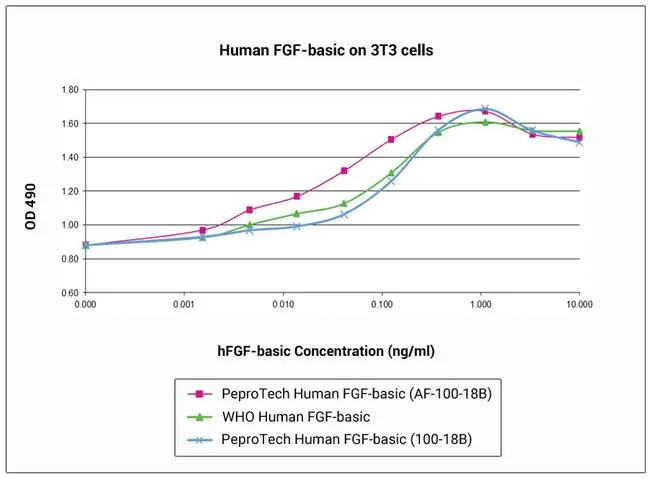
Activity | Determined by a cell proliferation assay using Balb/c 3T3 cells. The expected ED50 is ≤ 0.1 ng/ml, corresponding to a specific activity of ≥ 1 x 10^7 units/mg. |
Conjugate | Unconjugated |
Form | Lyophilized |
Purification | purified |
Contains | no preservative |
Storage conditions | -20°C |
Shipping conditions | Ambient |
Brochure User Manual Certifications OEM Product Link