Product Details
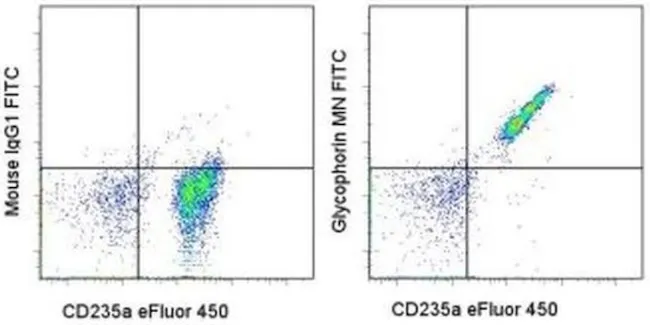
Description: The monoclonal antibody 10F7MN recognizes human glycophorin A (also known as CD235a). The antibody can see both the M and N alleles. Glycophorin A is a 151 amino acid sialoglycoprotein found on the erythrocyte (RBC) and erthyroid progenitor cell membrane at about 500,000 copies per cell. The gene for glycophorin resides on chromosome 4 and has 2 allelic forms: M and N, which differ in two amino acids. The M group possesses Ser1 and Gly5 while the N group has Leu1 and Glu5. Recent data suggest that exposure to toxins can cause mutation or loss of an allele resulting in phenotypic changes. Studies are also beginning to correlate genotype/phenotype with predisposition to cancer and heart disease. Applications Reported: This 10F7MN antibody has been reported for use in flow cytometric analysis. Applications Tested: This 10F7MN antibody has been pre-titrated and tested by flow cytometric analysis of normal human blood cells. This can be used at 5 µL (0.25 µg) per test. A test is defined as the amount (µg) of antibody that will stain a cell sample in a final volume of 100 µL. Cell number should be determined empirically but can range from 10^5 to 10^8 cells/test. Excitation: 488 nm; Emission: 520 nm; Laser: Blue Laser. Filtration: 0.2 µm post-manufacturing filtered. Target InformationGlycophorin A, also known as CD235a, is a 151 amino acid sialoglycoprotein expressed on the membrane of mature erythrocytes and erythroid progenitor cells, with approximately 500,000 copies per cell. The gene for glycophorin A is located on chromosome 4 and exists in two allelic forms, M and N, which differ by two amino acids: the M group has Ser1 and Gly5, while the N group has Leu1 and Glu5. These allelic variations define the blood group M and N specificities. Glycophorin A serves multiple functions, including providing a mucin-like barrier that minimizes aggregation between red blood cells in circulation, potentially preventing cell fusion. It also acts as a receptor for certain pathogens, including Sandei virus, parvovirus, and Hsa, a Streptococcus adhesin. Recent studies suggest that exposure to toxins can lead to mutations or loss of alleles, resulting in phenotypic changes. There is ongoing research correlating genotype and phenotype with predisposition to diseases such as cancer and heart disease, highlighting the importance of glycophorin A in both health and disease. Glycophorin A is a significant marker for studying erythrocyte-related functions and pathologies, as well as its role in pathogen interactions and disease predisposition. For Research Use Only. Not for use in diagnostic procedures. Not for resale without express authorization. |
Specifications
Applications | Tested Dilution |
Immunohistochemistry (IHC) | |
Flow Cytometry (Flow) | 5 µL (0.25 µg)/test |
Product Specifications | |
Species Reactivity | Human |
Published species | Human, Mouse |
Host/Isotype | Mouse / IgG1, kappa |
Recommended Isotype Control | Mouse IgG1 kappa Isotype Control (P3.6.2.8.1), FITC, eBioscience™ |
Class | Monoclonal |
Type | Antibody |
Clone | 10F7MN |
Conjugate | FITC |
Excitation/Emission Max | 498/517 nm |
Form | Liquid |
Concentration | 5 µL/Test |
Purification | Affinity chromatography |
Storage buffer | PBS, pH 7.2, with BSA |
Contains | 0.09% sodium azide |
Storage conditions | 4°C, store in dark, DO NOT FREEZE! |
Shipping conditions | Ambient (domestic); Wet ice (international) |
RRID | AB_10668830 |
Documents
Brochure User Manual Certifications OEM Product Link